Loan Programs
Bridge Loan Florida: Buy Before Selling in Michigan

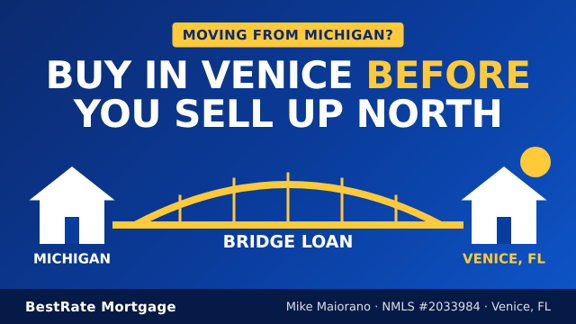
Yes—you may be able to buy a home in Venice before selling your Michigan property if you can access your equity and qualify while both homes are in the picture. A bridge loan is one option: it provides short-term funds for the Florida purchase and is generally repaid from the Michigan sale.
What a bridge loan does
In this situation, a bridge loan turns a portion of the equity in your Michigan home into funds you can use before that home sells. Those funds may help cover the down payment and closing costs on a villa, condo, or single-family home in Venice.
The basic sequence is:
- The lender estimates the usable equity in the Michigan property.
- The bridge loan provides funds for the Venice purchase.
- You close on the Florida home before completing the Michigan sale.
- The Michigan property sells.
- The sale proceeds pay off its existing mortgage and the bridge loan.
Loan structures vary. A bridge loan may sit behind the existing mortgage or may be structured to replace other debt on the property. Its interest rate, payment requirements, fees, maturity date and extension options depend on the lender and the specific transaction.
For a conventional mortgage delivered to Fannie Mae, a bridge loan can be an acceptable source of purchase funds if it is not cross-collateralized against the new property and the lender documents that the borrower can carry the relevant obligations. Fannie Mae does not set a universal maximum bridge-loan term in its bridge and swing loan guidance. (selling-guide.fanniemae.com)
Start with qualification, not available equity
A large amount of home equity does not automatically make a bridge strategy workable. The more important question is whether the complete financing plan qualifies.
While you own both properties, the lender may need to account for:
- The Michigan home’s principal, interest, taxes, insurance and association dues
- The bridge-loan payment or required monthly obligation
- The proposed Venice housing payment
- Car loans, credit cards and other recurring debts
- Required cash reserves
- Closing costs and moving expenses
Under Fannie Mae’s current guidance, the bridge-loan liability generally enters the debt-to-income calculation. It may be excluded when the lender has a fully executed contract for the current home and confirmation that the buyer’s financing contingencies have cleared, as explained in its monthly debt obligations requirements. (selling-guide.fanniemae.com)
Similar rules apply to the Michigan housing payment. If that residence will not transfer to its buyer before the Venice closing, both the current and proposed housing payments generally count. Fannie Mae’s September 2, 2026 guidance provides an exception when the required sale contract and financing-contingency documentation are in place. See Qualifying Impact of Other Real Estate Owned. (selling-guide.fanniemae.com)
That distinction matters. A home that is merely listed is different from one under a firm contract with the buyer’s financing contingency cleared.
The safest bridge-loan plan starts with the exit: know how the loan will be repaid if the Michigan home takes longer to sell or nets less than expected.
How to evaluate the real cost
There is no single “standard” 2026 bridge-loan rate or fee schedule. Pricing varies by lender, loan amount, lien position, credit profile, property and expected repayment period.
A useful comparison should include more than the advertised interest rate:
- Origination or lender fees
- Appraisal, title and recording charges
- Monthly interest or required payments
- Minimum interest requirements, if any
- Maturity and extension fees
- Prepayment provisions
- The cost of carrying both properties
- The effect of a delayed or lower-than-expected Michigan sale
The basic cost calculation is straightforward:
Total bridge cost = lender and third-party fees + interest paid while the loan is open + extension or other applicable charges
The sale timeline often has the greatest effect on the final cost. A strategy that works comfortably with a three-month sale could become much tighter if the property remains unsold for eight months.
It is also important to estimate net proceeds conservatively. Fannie Mae’s anticipated sales proceeds guidance calculates estimated proceeds by subtracting liens and selling costs; when no sales price has been established, the guidance also calls for an adjustment to the listing price based on market conditions. (selling-guide.fanniemae.com)
Bridge loan versus the alternatives
A bridge loan is not automatically the best way to buy before selling. The recommended approach is to compare the available paths using the same purchase price, estimated sale proceeds and timeline.
| Option | Why it may fit | Main tradeoff |
|---|---|---|
| Bridge loan | Converts existing equity into purchase funds before the sale | Short-term interest, fees and the risk of a delayed sale |
| HELOC | Provides flexible access to equity through a revolving line | Often has a variable rate, and terms depend on the lender |
| Carry both mortgages | Avoids adding a separate equity loan | Requires enough income, assets and reserves to qualify |
| Sale-contingent offer | Reduces the need for temporary financing | May be less attractive to a seller who wants a firm closing |
| Sell first | Removes uncertainty about proceeds and payoff timing | May require temporary housing or a rushed Florida search |
| Larger new mortgage, then recast | Uses sale proceeds later to reduce the payment | Availability and requirements depend on the loan and servicer |
HELOC versus bridge loan
A home equity line of credit may be worth considering when there is time to arrange financing before the move. Unlike a lump-sum bridge loan, a HELOC usually allows the borrower to draw only what is needed, subject to the line’s terms.
HELOCs can include application, origination, appraisal, title, annual, inactivity or early-cancellation fees. The Consumer Financial Protection Bureau recommends reviewing the complete fee structure, not just the initial rate. Its HELOC fee guidance also notes that plans may include costs for converting part of a balance to a fixed rate. (consumerfinance.gov)
Because lender policies differ, a HELOC should be evaluated before the Michigan property is listed—not after a Venice offer has been accepted and funds are urgently needed.
Recasting after the Michigan sale
Another possible strategy is to take a larger mortgage on the Venice home, apply part of the Michigan sale proceeds to the principal, and ask the servicer to recalculate the monthly principal-and-interest payment.
This is called re-amortization or recasting. It does not change the original interest rate, and it is not universally available. Fannie Mae’s servicing guidance provides a process for re-amortization after a substantial principal reduction, but the borrower must still confirm eligibility and procedures with the applicable lender or servicer. (servicing-guide.fanniemae.com)
A special warning for HECM for Purchase buyers
A bridge loan or HELOC should not be treated as a down-payment solution for a Home Equity Conversion Mortgage for Purchase.
HUD’s current HECM guidance requires the lender to document acceptable sources for the borrower’s monetary investment and confirm that the borrower did not incur an unpaid obligation in connection with the purchase. HUD’s counseling handbook states more directly that HECM for Purchase borrowers may not borrow their funds to close. See HUD’s HECM counseling guidance and FHA Single Family Housing Policy Handbook. (hud.gov)
Anyone considering a reverse mortgage purchase should have that financing plan reviewed separately instead of assuming ordinary bridge-loan rules apply.
Build the plan around a buy-before-you-sell checklist
The unresolved question is rarely just, “Can I get a bridge loan?” It is whether the bridge, the new mortgage and the Michigan sale still work together under a less-than-perfect timeline.
A complete checklist should organize:
- Estimated Michigan value and current mortgage payoff
- Expected selling costs and conservative net proceeds
- Venice down payment and closing costs
- Both homes’ monthly carrying costs
- Bridge or HELOC terms and fees
- Cash reserves after the Florida closing
- Expected Michigan listing and sale dates
- The bridge maturity date
- A backup plan for a delayed sale
- Recast options after the sale
Because I work with borrowers in both Michigan and Florida, I look at the move as one connected transaction rather than two unrelated mortgages. That means comparing the equity leaving the Michigan property with the cash, qualification and timing required for the Venice purchase.
Plan the move before committing to the financing
The right approach may be a bridge loan, but it could also be a HELOC, a firm sale contract, the ability to carry both homes, or a later recast. The decision should be based on documented proceeds, complete carrying costs and a realistic backup plan—not equity alone.
Review the buy-before-you-sell checklist to organize the figures and timing questions that need to be resolved before choosing a strategy.
Frequently asked questions
Can I buy a home in Venice before selling my Michigan house? +
Potentially, yes. Common approaches include a bridge loan, HELOC, qualifying with both housing payments, or making the Florida purchase after the Michigan home is under a firm contract.
Does a bridge loan count in my debt-to-income ratio? +
It generally does for a conventional loan following Fannie Mae guidelines. An exception may apply when the current home has an executed sales contract and the buyer’s financing contingencies have cleared.
Is a HELOC better than a bridge loan? +
Neither is universally better. A HELOC may offer flexible access to funds, while a bridge loan may be structured specifically around the sale, but rates, fees, payment terms and lender requirements must be compared.
What happens if my Michigan home takes longer to sell? +
You may have to carry the bridge loan and both properties longer than planned. Before closing, review the loan’s maturity, extension provisions, cash reserves and backup options for reducing the Michigan home’s time on the market.
Can I recast my Venice mortgage after the Michigan home sells? +
Some loans and servicers permit re-amortization after a substantial principal payment. Confirm availability, minimum-payment requirements and any fees before relying on a recast as part of the plan.

About the author
Mike Maiorano — Mortgage Broker
NMLS #2033984
I'm Mike Maiorano, a mortgage broker (NMLS #2033984) and the person behind Bestrate Mortgage (NMLS #1852295), based in Venice, Florida and lending in Michigan, Florida and 10 other states. As a broker, I shop multiple lenders instead of selling you the one product a bank happens to have.
More about Mike →Ready to talk numbers?
Schedule a 15-minute call. We'll walk through your situation and show you what's actually possible — no pressure, no pitch.
Book a call
